Showing posts with label warehouse automation. Show all posts

Tuesday, 27 February 2018

Case Study-Chongqing Medicine Co., Ltd.

Unit load AS/RS (5 cranes, stores 4,131 pallets) is 24m (79ft) high under the beams.
        

Chongqing Medicine Heping Drugstore is China’s largest drugstore chain. Heping Drugstore is owned by pharmaceutical wholesaler Chongqing Medicine Co., Ltd. In April 2007, Chongqing Medicine expanded and renovated its Peace Distribution Center by introducing a unit load automated storage & retrieval system (AS/RS), high-speed sorting transfer vehicles (STV), and warehouse management system software (WMS). The new equipment automated receiving, picking, replenishment, and shipping. The new DC uses less power and labor, while providing increased storage and improved order processing capabilities.

For more information, visit http://www.daifuku.com/in/solution/casestudy/chongqingmedicine/

Thursday, 22 February 2018

Case Study-Modern AS/RS technology improves efficiency at two distribution centers


Input lines to the unit load AS/RS.

With 520 stores throughout Sweden, Dagab AB is one of the country’s four largest grocers. As part of an ongoing effort to efficiently serve customers, Dagab recently renovated two distribution centers. One serving customers in northern Sweden and the other serving customers in the south. In both facilities, cutting-edge material handling systems reduced cost and decreased delivery lead time. With the new systems in place, Dagab will be able to efficiently manage future growth.

Dagab AB opened the Stockholm distribution center near its head office in June 2008. It consists of dry, cold, and frozen areas. A unit load Automated Storage and Retrieval System (AS/RS) and Sorting Transfer Vehicles (STVs) were introduced to handle dry products.
The AS/RS consists of six storage retrieval machines and has a storage capacity of 12,000 pallets. It handles full europallets (900mm x 1,400mm) and half-pallets (900mm x 700mm). Half-pallets are stored double deep

For more information, visit  http://www.daifuku.com/in/solution/casestudy/dagab/


Tuesday, 13 February 2018

Case study-FANCL Corporation


1.  Container aligning line. Containers containing picked items by category are gathered up in units of store. RFID antennas are set in two-high constructor to cope with two tier containers.

FANCL Corporation (headquartered in Yokohama, Kanagawa) was established as a mail order company of additive-free cosmetics. Today, FANCL also sells health supplements, food, and drinks in retail shops and convenience stores around Japan. In August 2008, FANCL opened a new facility “Kanto Distribution Center” to centralize operations of eight locations. In addition to installing automated material handling systems at its new facility, FANCL also added 14,000 RFID tags to improve order fulfillment accuracy. The distribution center strives for over 90 percent same-day delivery and nearly “zero-error” shipping accuracy


For more information, visit http://bit.ly/2o5r9DG

Sunday, 4 February 2018

TPM: Critical Approach to Optimal Productivity


Considered as the medical science of machines, TPM (Total Productive Maintenance) is an innovative concept introduced by the Japanese to the world. Japan, known to be the master in quality production, the origin of TPM can be traced way back to 1951, when preventive maintenance was introduced in Japan. With increasing automation, regular and preventive maintenance of machines became crucial to increase productivity.
TPM: The Idea Behind
The ideas behind introducing TPM was to get operators involved in maintaining their equipment and make them responsible for their machines, such that they proactively carry out maintenance to improve and achieve perfect production, targeting zero breakdowns, losses and defects along with ensuring a safe working environment.
What is TPM?
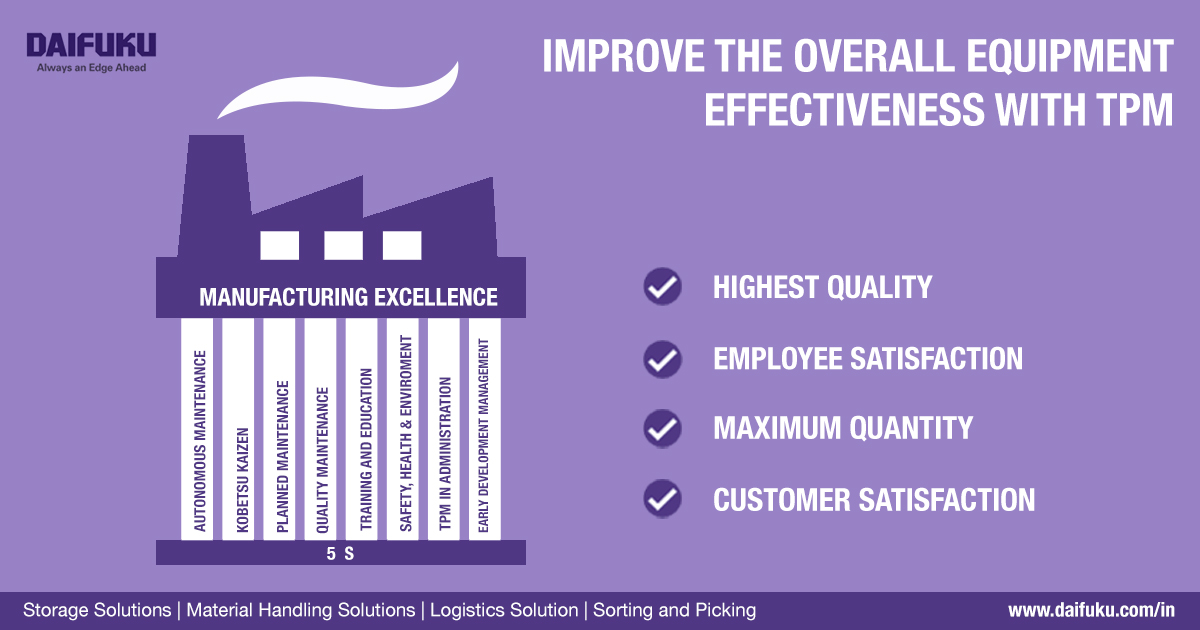
To be precise, TPM is a timely maintenance program carried out in a factory to increase productivity of its machines and equipments with modest investments in maintenance.  TPM has a holistic approach to improve the Overall Equipment Effectiveness (OEE) of plant equipments which is its main objective, along with improving the quality and quantity of production, boosting employee morale and job satisfaction. TPM includes 4Ms and T- Man, Machine, Material, Method and Tools. TPM creates the right environment between all these factors of production, which helps maximize the operational efficiency and achieve manufacturing excellence. Here if we see, efficient material handling is crucial for successful TPM.
TPM vs. TQM
Though they share lot of similarities, but they are two different approaches. Both result in improved quality but both follow two distinct paths. TQM focuses on improving quality of the goods and services and concentrates, while TPM focuses on equipment and process used to produce the product thus maintaining quality, reducing cost and increasing volume of production.
The 8 Pillars of TPM – Way towards achieving Manufacturing Excellence
5S- Sort, Systematise, Sweep, Standardize, Self-discipline- The Foundation
5S is the very foundation on which the 8 pillars of TPM stand.  It is so because, when the house would be in order, then only the pillars of TPM can exist. Organizing the workplace with 5S sets the workplace in order, which helps make problems easily visible and makes workplace clean and well-organized, ready to set the 8 Pillars of TPM.
Pillar 1- JISHU HOZEN (Autonomous Maintenance) - Small maintenance tasks on continual basis
Making operators responsible for the upkeep of their equipment with small, regular tasks to help prevent their equipment from deteriorating;
Pillar 2- KOBETSU KAIZEN (KK) - Small improvements on a continual basis
Kaizen is the most well-known philosophy introduced by Japan to the world. Kaizen simply means ‘change for better ‘through continuous improvement, which is not only pertaining to manufacturing but improvements in all areas of a company;
Pillar 3- Planned Maintenance- Proactive and Reactive method
 Scheduled maintenance based on the predicted and measured failure rates to have trouble free machines and defect free products. Customer satisfaction is the final aim;
Pillar 4- Quality Maintenance- Proactive method
The goal for any manufacturing facility is to have ‘defect free manufacturing’. This is achievable only by maintaining highest level of quality standards. Quality Maintenance on time can ensure being proactive in Quality Control to Quality Assurance, help detect errors and eliminate them to maintain quality to have zero customer complaints;
 Pillar 5- Training and Education- A well informed workforce
In order to do away with the knowledge gaps, the workforce has to be well- informed. The Operator should develop skills not only to know how the machine works, but also should understand the reason behind emerging problems, if any. Training and Education develop the personnel’s skills and techniques to deal with a particular problem in a proactive way. Proper Training of the personnel is necessary for achieving TPM goals;
Pillar 6- Safety, Health and Environment (SHE) - Peripheral Necessities
The aim is to have an ‘accident free workspace’. It focuses on the elimination of potential risks of accident and fires. It makes the workplace operator-friendly by taking timely safety measures through dedicated personnel taking care of it;


Pillar 7- Development Management- New Product Development
Before any new product is incorporated in the manufacturing process, getting practical knowledge of the new product helps easy amalgamation of it, into the ongoing processes and also helps reach the pre-planned maintenance level soon. TPM provides understanding of the new equipment which supports in designing and developing the new product;

Pillar 8- TPM in Administration- Support to the plant operations
Improving Administrative function is crucial for improving plant functioning and increasing productivity. It also includes analyzing the process and procedures to eliminate losses. TPM in administration is a step usually taken after the four basic pillars of TPM are in place.
            To add to this, Material Handling is considered to be another pillar of TPM. The linking element between man, machine, material and method is material handling. Increase in total productivity cannot be possible if material handling is not organized.
            Companies introducing TPM in their factories start with implementing the first 4 pillars (JH, KK, Planned Maintenance and Quality Maintenance) initially and then slowly widen their scope to include the remaining pillars to have complete implementation done. A new factory or a factory introducing TPM, if introduces efficient material handling systems at the beginning, it will always lead to successful implementation of TPM.
Advantages of introducing TPM in a factory
When it comes to Productive Efficiency, TPM is the answer for every factory. TPM addresses all facets of the factory from material, machines, equipment, processes to employees. It brings in a positive approach in workers by bringing them into the loop of being responsible for their machines and its production. It helps workers in developing multiple skills to become flexible. When it comes to machines, machines also become efficient because of timely maintenance. Regular maintenance ensures that systems and machines do not reach the stage of extremity like breakdowns, accidents etc . It ensures defect free production along with maintaining the highest level of quality. Also, the benefit of TPM in administration adds to this, by having involvement of all people in support functions, with a focus on improving the plant performance. This results in the improvement of Overall Effective Efficiency (OEE) of the plant.
My TPM Mantra: TPM leads to TPM
By this I mean to say, Total Productive Maintenance leads to Total Profit Management. When TPM ensures zero defects, zero losses and zero accidents with maintaining highest level of quality, the result is customer satisfaction and increase in profit to business. If we do the cost-volume-profit analysis for an organization having introduced TPM effectively, the total revenue exceeds the total cost with increase in productivity, and the total profit increases.
Daifuku’s Role with TPM
Along with implementation , making way for the success of TPM starts with efficient material handling. DAIFUKU provides the means to achieve TPM Goals, with its Automated Storage and Retrieval Systems.SA/RS ensures providing industries best in class material handling solutions giving unique solutions. Reaching TPM goals- Zero Defects, Zero Losses and Zero Accidents’ is made easy and effective with DAIFUKU AS/RS. The Automated Storage Solutions help utilize manpower efficiently and save on space. Automation and optimization increase productivity and help improve quality and quantity of production, setting new levels of manufacturing excellence and customer satisfaction.
About the author
Mr. Asim Behera is presently the COO at Factory Automation and Distribution Automation; Daifuku India. With his esteemed direction and guidance, Daifuku has become the fastest growing ASRS Company in India. He is a business veteran, a guest speaker at various industry platforms such as CII, ASSOCHAM, CEMAT, IWS, and Symbiosis University and an expert in automated storage & retrieval systems and material handling systems. His experience in varied markets such as India, US, Europe, & Japan helps companies set up market entry strategy for new technologies and services.
About Daifuku
Since 1937, Daifuku has been world-class Automated Materials Handling Company – conveying, storage, sorting, picking and controls. We have a global network of offices and subsidiaries that offer design, engineering, sales, installation and commissioning of an Automated Storage and Materials Handling System.

For more information, visit http://www.daifuku.com/in/

Wednesday, 31 January 2018

Innovations in Warehousing


Transforming over time from godowns to warehouses, warehouses have grown to become the backbone of the manufacturing and the service industry. Traditionally warehouses meant humongous spaces managed by a huge manpower. There have been businesses that have been solely dependent on managing warehouses. Today, the very nature of handling such space is changing. 
With supply chain getting advanced and evolved over time, warehousing  is on a continuous improvement process. The volume of material handling these days, demands use of automation instead of a large workforce. This is to meet the expectations of accuracy and on time delivery. In today’s world speed is everything, it can be your competitive edge.
Specially in the manufacturing industry, with lean manufacturing and lean inventory becoming the aim, having sophisticated material handling systems has become the need of the hour. Similarly, growing consumerism especially with modern retail and ecommerce in particular has led to ever increasing amount of logistics handling in the service sector, for which proper warehousing stands crucial for survival.
Warehousing in India
India- The changing scenario
Demand for modern and sophisticated warehouses has witnessed a tremendous increase in India in last few years because of influx of multinational companies as well as export-oriented companies who are ready to invest in the warehousing infrastructure.
Need for large scale warehousing or dedicated logistics parks is fast catching up in India. The industry is mostly fragmented and unorganized; dominated by many small players. Also, the role of warehouses has increased due to wider product range, emphasis on shorter lead times and constant changes in customer demand with changing dynamics of the country.
In a recent study done by World Bank, India has jumped 19 positions in the Logistics Performance Index (LPI) which means India is on the growth path as far as the Logistics handling capacity is considered. Also, in 2017, India made the highest ever jump to come within the top 100 countries in the “Ease of Doing Business’ index of the World Bank. This indicates that, India is becoming a preferred destination for global companies.  
 Although India is on the path of technological advancement, more needs to be done. Out of the many fields, warehousing and logistics management is one such important field that needs attention. The warehousing industry in India is growing at a rate of 10 percent every year. Considering the current scenario, the growth in Indian warehouse industry is led by various factors, prominent amongst them are:-
      growth in manufacturing, engineering and service industry;
      growth in e-commerce, modern retail, digitization, government thrust on cashless economy;
      growth in domestic consumption;
      fast growing exports and international trade;
      growth in private and foreign investments with government’s Make in India Campaign;
      introduction of GST integrating India into a unified market;
      increase in trade through foreign investments in the SEZs(Special Economic Zones)
      growth in openness of the Indian economy and market integration;
According to studies, Indian logistics market is expected to grow at a CAGR of 12.17% by 2020 driven by the growth in the manufacturing, retail, FMCG and e-commerce sectors.
Why innovating in warehousing is crucial?
In today’s globalized world the cost of manufacturing a well specified product is pretty much the same anywhere in the world. Then there is the market price which is determined by the consumer base. So with the input and output prices being controlled by external influences, one of the few areas where companies can leverage competitive advantage is their supply chain of which warehousing is a part. So innovation in the warehouse become not only crucial but necessary for survival. Some other issues specific to industry and India are as follows:
Labour Problems- Labour in India though available in large number as well as cheaply, its not easy to manage them and they are highly unskilled. Compared to other countries, labour in India don’t receive proper training and thus lack industry knowledge. Hence, there are issues of labour union, regulation issues and differences between labour unions and company’s management.
Bulky Material- Industries like textile, iron and steel industry etc. handle huge quantity of bulky material everyday. A large workforce is required to handle such huge quantity and managing such a large workforce requires more management and safety is always a concern.
Environment issues- With mass productivity being the prime moto today, industries face problems of space availability, land issues etc. Sometimes challenging environment to work in like in cold storages, high work temperature areas also hinder the productivity of workers. In such cases replacing man with machines can be a boon .

Solution to problems of Warehousing
Automation and optimization are key to Innovations in warehousing.
Harnessing the power of technology and maximizing a facility's potential can be a competitive edge. This demands companies improve their warehousing facilities and advance their logistics handling with efficient supply chain management environment. One such expert in materialhandling solutions and logistics management is Daifuku.
Daifuku, provides its expertize in utilizing the warehouse space optimally with its custom-made solutions. Daifuku’s AS/RS helps pace up the movement and use the right amount of space with the least human dependency in a safe way.
A final word
Innovations in warehousing will most certainly help achieve improved operating efficiency, cut cycle time, prevent material handling loss and provide controlled access. Daifuku’s products such as AS/RS, Unit Load AS/RS, Mini Load AS/RS, Racking Systems help deliver speed and effciency for today’s supply chain management (SCM) environment. Daifuku caters to all types of customer needs and designs and builds ensuring high quality and long-term reliability.
About the author
Mr. Asim Behera is presently the COO at Factory Automation and Distribution Automation; Daifuku India. With his esteemed direction and guidance, Daifuku has become the fastest growing ASRS Company in India. He is a business veteran, a guest speaker at various industry platforms such as CII, ASSOCHAM, CEMAT, IWS, and Symbiosis University and an expert in automated storage & retrieval systems and material handling systems. His experience in varied markets such as India, US, Europe, & Japan helps companies set up market entry strategy for new technologies and services.
About Daifuku
Since 1937, Daifuku has been world-class Automated Materials Handling Company – conveying, storage, sorting, picking and controls. We have a global network of offices and subsidiaries that offer design, engineering, sales, installation and commissioning of an Automated Storage and Materials Handling System.

For more information, visit http://www.daifuku.com/in/